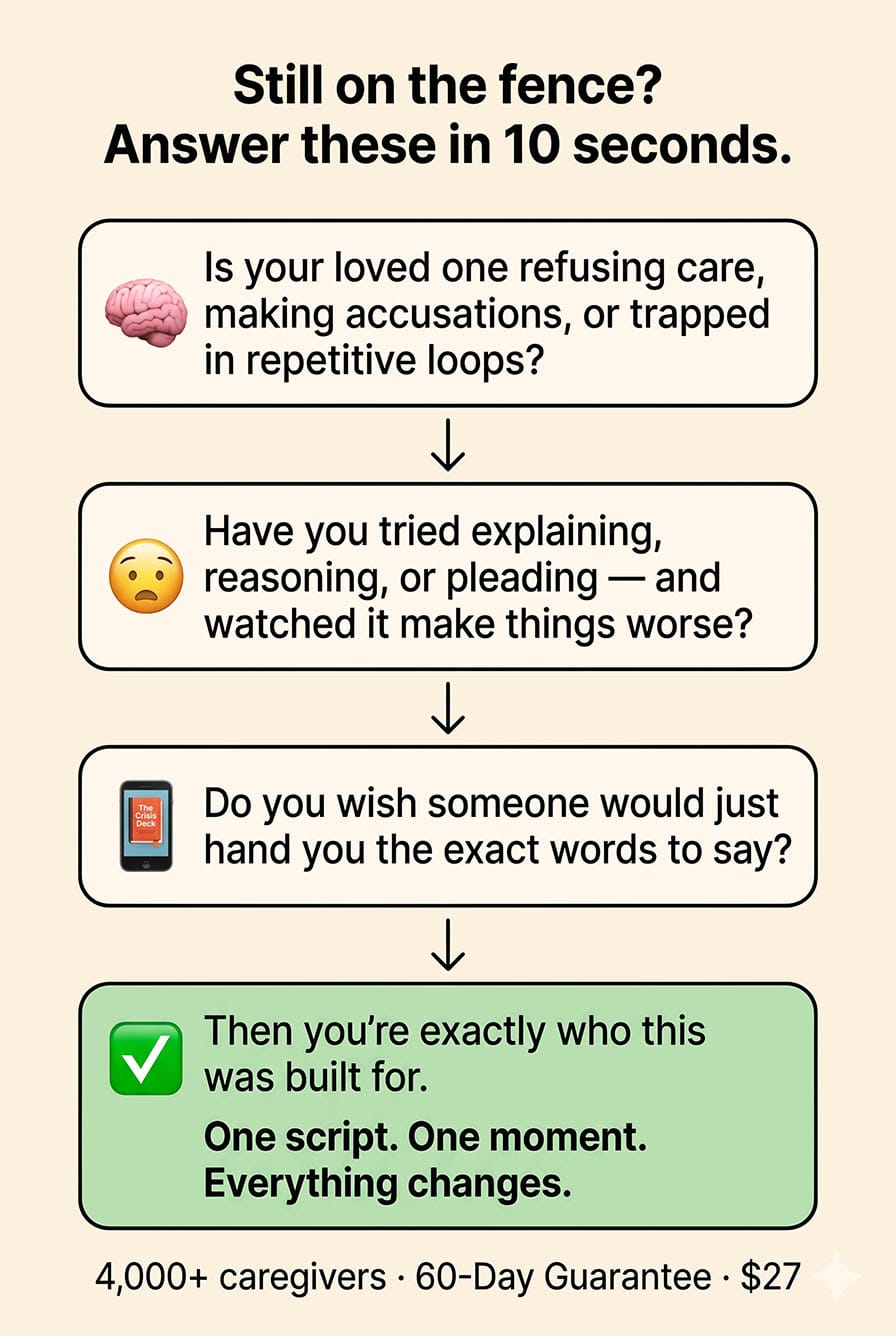
I said I wouldn't argue. Then I did. Again. Then I tried a script. It worked.
The only thing built for use IN the moment. Every other caregiving tool assumes you have the time to read and learn. This one doesn't.
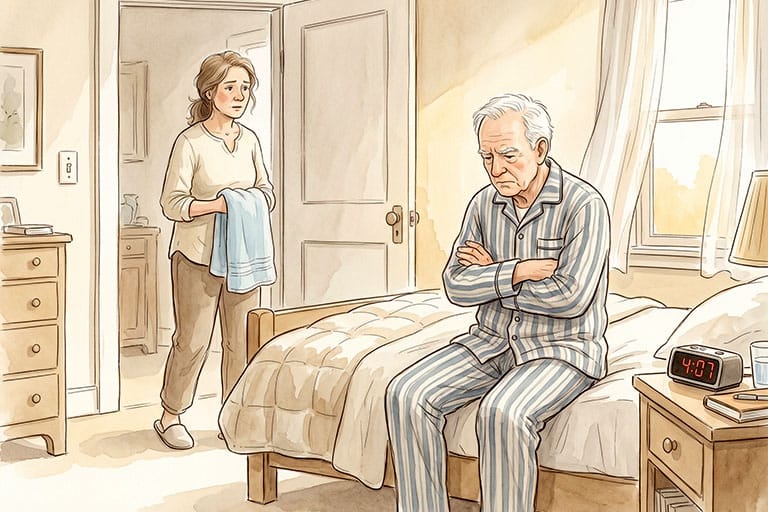
It was 4:07pm and I could feel it starting in my chest again. That familiar tightening. The resignation. The dread.
You know that feeling? When you promised yourself last night you'd stay calm today… But they're refusing to shower again. And you need something that works right now. Not after six weeks of reading. In the moment, when you're BOTH about to lose it. Except this time, I had a script in my pocket.
💚 60 days to try it. If it doesn't help, full refund AND you keep the deck. You can't lose money on this.
📱 Instant access — on your phone in the moment · 🖨️ print at home anytime · 📄 PDF, ePub & Google Doc — no apps required
🎁 FREE with purchase: 4 bonus resources — Capacity Worksheet, Extinction Burst Survival Guide, Paid Help Navigator & Script Customization Guide
The math that made me stop hesitating:
• 1 session with a geriatric care manager: $200+
• That caregiver course collecting dust: $97
• Too many dementia books: $60
• Support groups that said to "set boundaries": $0 — and still useless at 2am
Total spent trying to fix this: $357+
The tool that actually works: $27.
Use it the next time it happens. Always have it ready. Full refund if it doesn't help.
That's just $0.45/day for 60 days. Less than your morning coffee.
💥 You're Not the Only One Who Feels This Way

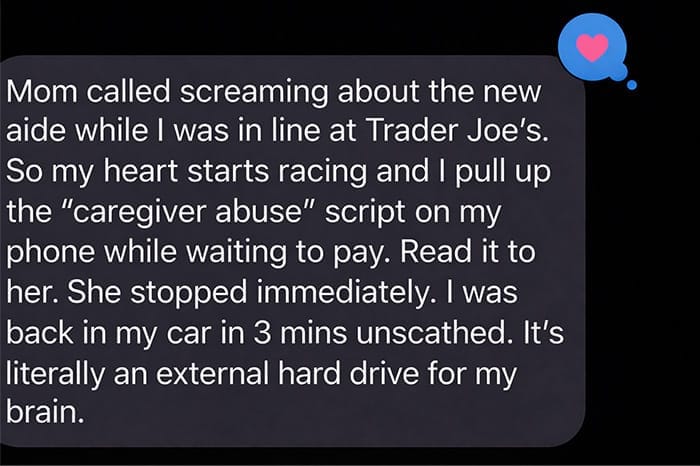
I know because I get messages like this every day:
You're not broken. You're not a bad daughter, son, or spouse.
It's not you. You're just missing the tool.
And if you've already tried the gentle approach that made them angrier…
The firm approach that made them cry…
The logic that bounced right off because there's no logic left to reach…
The piles of advice that left you with nothing to say at 2am…
This was built specifically for you.
Some mornings I hide in the bathroom just to cry for 30 seconds of quiet.
Bracing myself. Rehearsing things I'll say. Knowing they won't work.
Missing the person I was before this.
I love them more than anything… but I'm running on empty.
And I feel like I'm doing it all alone while everyone else seems fine.
And 4,000+ caregivers felt exactly the same way… until they found something that actually worked.
🧠 Here's What Nobody Tells You About Cognitive Decline
Your loved one's brain during a conflict? Completely offline.
- Logic? Nice try.
- Consequences? Can't process them.
- "Take deep breaths"? Might as well be speaking Chinese.
But here's what nobody tells you: you can't redirect their brain when yours is flooding too.
You don't need another 'technique'.
You need the exact words. RIGHT NOW.
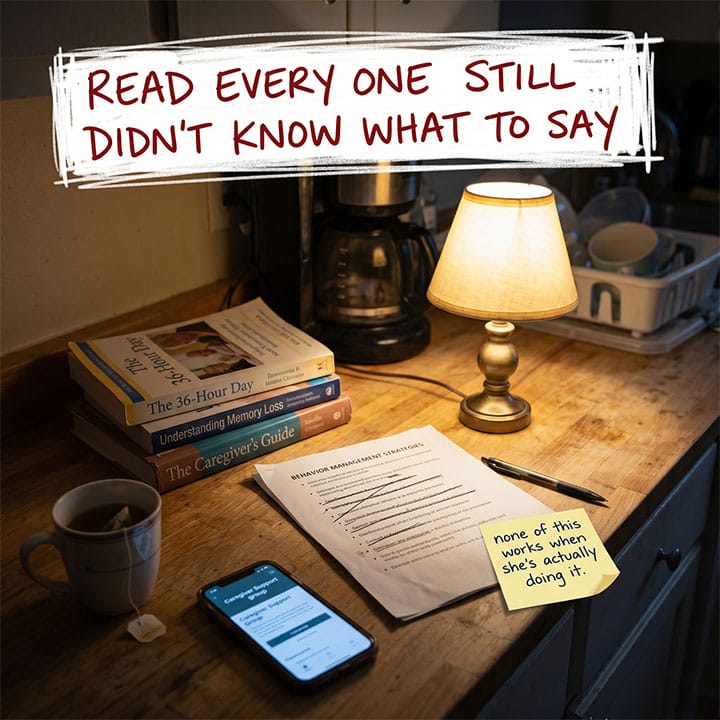
🛠 I Built This Tool Because I Needed It First

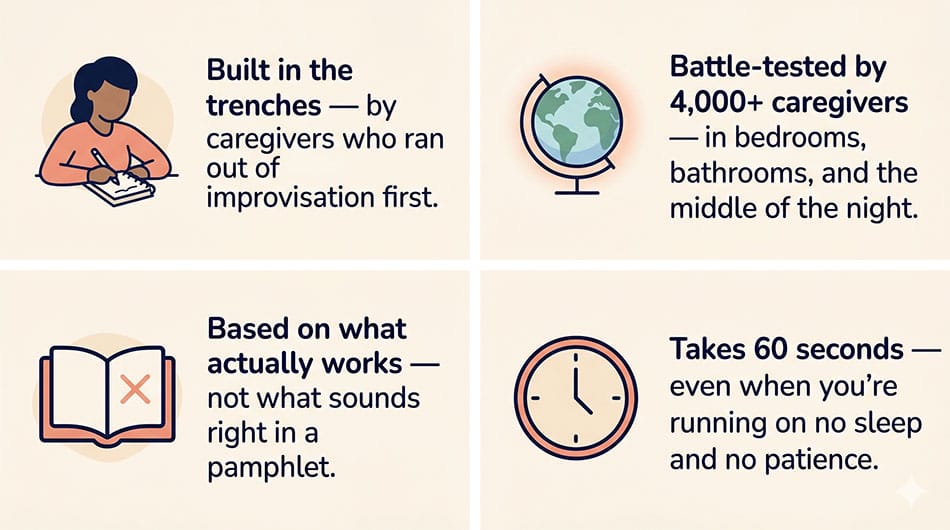
I'd read the books. I'd watched the videos. I understood that logic doesn't work on the dementia brain. I just had no idea what to use instead.
So when my mother refused to shower? I froze. Every single time.
One night she'd been up for hours, completely convinced someone had broken in — and I just sat on the floor and Googled "what to say when parent with dementia won't calm down."
A million results. Nothing useful. Everyone told me WHAT to do. No one told me what actual WORDS to use.
So I built it. With the help of work by occupational therapists, dementia care nurses, and caregivers who showed us what actually works.
📋 The Crisis Deck. Your 60-Second Lifeline.
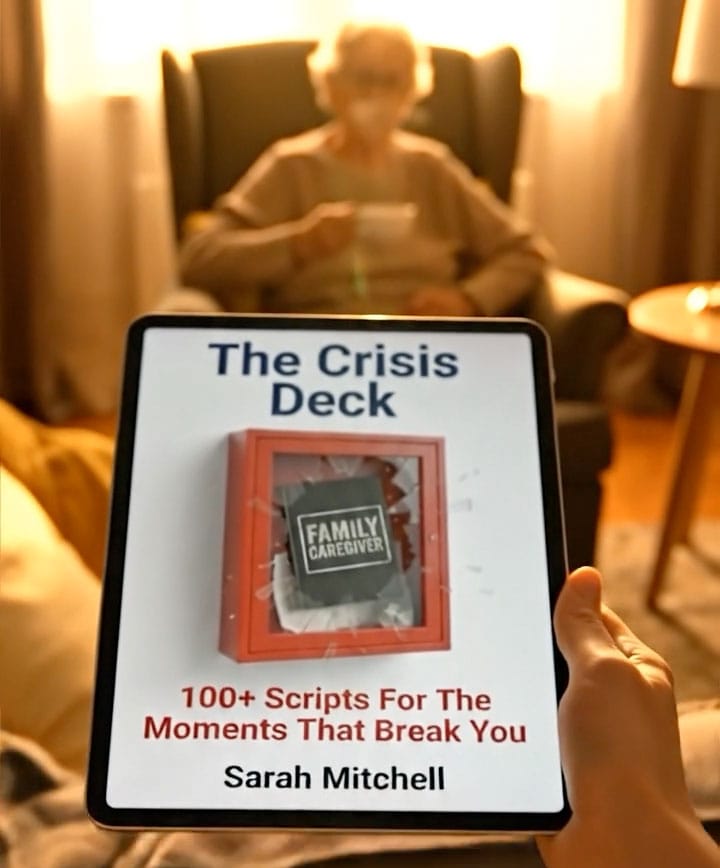
100+ scripts. 12 categories. Word-for-word. Use it the next time it happens.
Every script gives you:
- ✅ The exact words to say (so your mind doesn't go blank)
- ✅ Why it works (so you use it with confidence, not hope)
- ✅ Escalation follow-ups (for when the first line isn't enough)
✨ Find · Read · Watch
(Refusals, Aging Brain…)
word-for-word script
you stop arguing
That's it. Even fumbling your way through it is better than your old pattern.
No apps to download. No techniques to memorize. Just use the script and get relief.
Use it on your phone. Print the pages you need. Keep them in your pocket, in the car, on the fridge.
Because crises don't wait for the perfect moment.
Why it works:
You don't need a new technique. You just need the right words.
Here's what most caregiving resources miss — these scripts work when you're BOTH losing it.
When you're slept out, talked out, totally done.
Because most tools assume you're calm enough to use them. This one doesn't.
- ✔ No courses. No lectures. No behavior frameworks to memorize.
- ✔ No manual. No training. Just grab and go.
- ✔ One script. One moment. Everything can change.
Feeling overwhelmed by 100+ scripts?
Start with just ONE: The Hygiene Pivot.
Next refusal, open it, read it, see what happens.
The other scripts will be there when you need them.
And look — you don't have to use it perfectly.
Half the time I was fumbling while she was mid-conflict.
But even just having SOMETHING to reach for instead of my old pattern of arguing and explaining…
it changed everything.
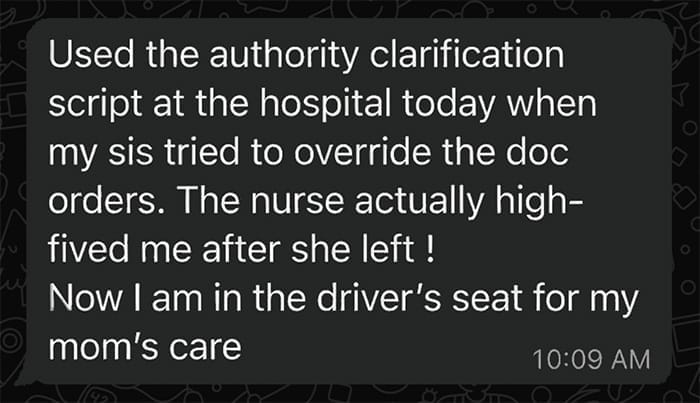
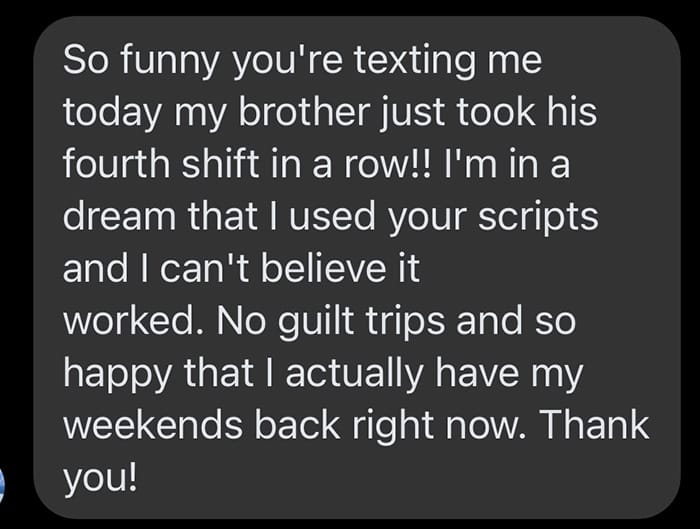
And there are still days when I'm too exhausted to even find the script.
Days when I just… say the wrong thing anyway.
But now those days are the exception, not the default.
📄 One Script. Many Variants. Completely Done For You.
Each script has multiple variants for different situations or stages of cognitive decline.
Understand the mechanism and use the escalation follow-ups.
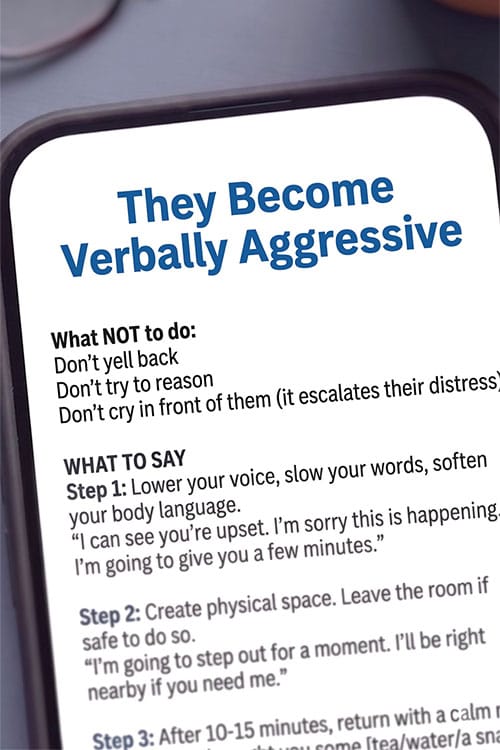
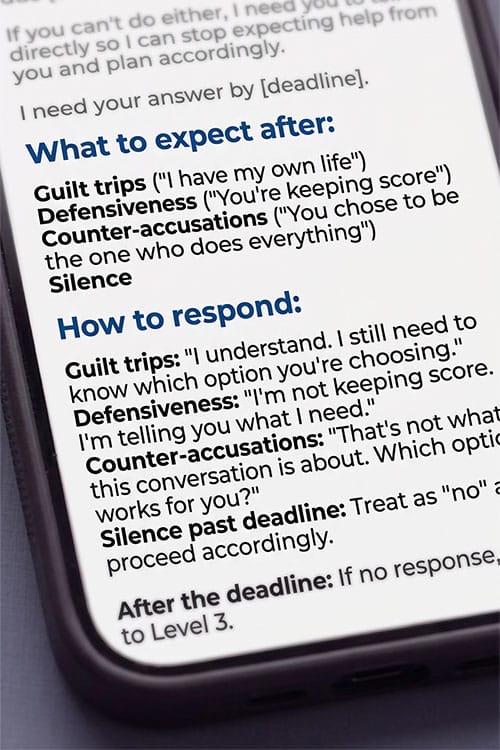
You don't have to remember what the book said.
You don't have to think clearly under pressure.
You just read.
📦 What's Inside
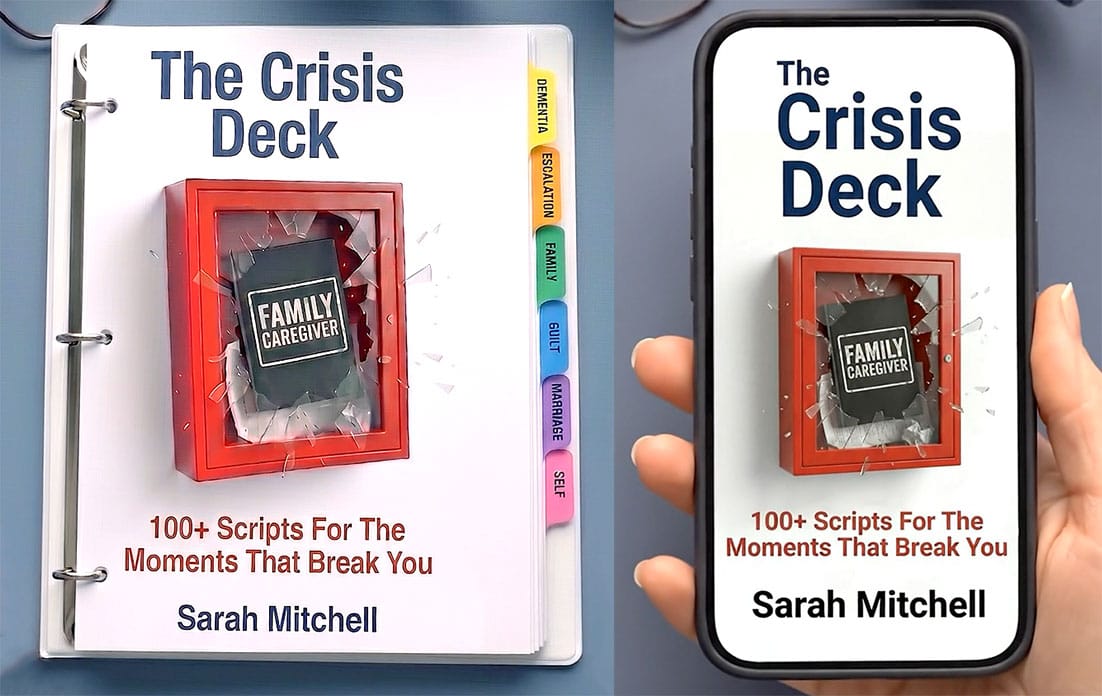
100+ word-for-word scripts. Organized into 12 categories so you can find what you need fast.
- 📋 The "Refusals" Pack — For when they won't shower, won't eat, won't take meds, or won't get in the car
- 🧠 The "Aging Brain" Protocol — When they don't recognize you, accuse you of stealing, hallucinate, or ask for someone who died
- 🛡 The "Hardest Parts" Shield — For the things no one talks about — soiling, smearing, inappropriate intimate behaviour, and what to do when they start screaming in public
- 🔑 The "Keys" Trick — How to handle them wanting to drive — without you being the villain
- 👥 The "Sibling" Smackdown — When they won't help, won't pay, or won't visit — organized by relationship dynamic
- 🔁 The "Loop" Breaker — Handle repetitive questions ("What time is it?", "I want to go home") without losing your mind
- 💚 The "Guilt" Eraser — Self-talk scripts to stop feeling like a bad person when guilt sets in
- 💑 The "Marriage Saver" Pack — When caregiving is killing your relationship
- 🕊 The "End-of-Life" Opener — Break the ice on the hardest conversation, with dignity
Open them on your phone in the moment, or print at home and keep a set in the bathroom, the car, on the fridge. However you need them, wherever the crisis happens.
Start tonight →🌅 Picture Tomorrow at 4pm
What if…
…you stayed calm when your loved one didn't?
…you handled a refusal without arguing, and felt competent, not ashamed?
…you ended the day still recognizing yourself?
This is what's waiting on the other side of one script.
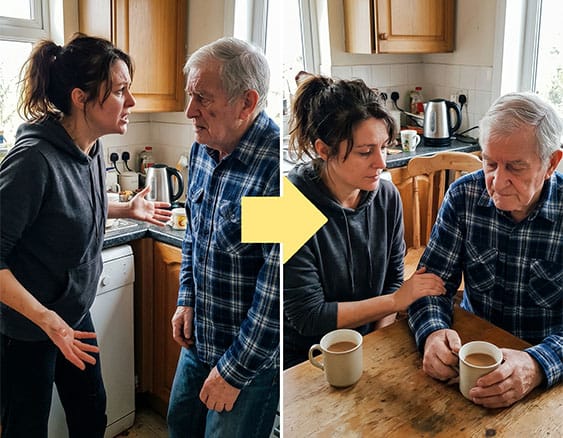
Before: Tuesday, 4:07pm. She's refusing to change clothes again. You've explained it three times. Your chest is tight. You can feel yourself about to say something you'll regret.
After: Same afternoon. 60 seconds later. You use The Hygiene Pivot. She looks at her shirt. She says "oh gosh, let's sort that out." She's changes. Life goes on.
They refuse. This time… you don't take it personally. You find the script and read the words. You feel your shoulders drop. Your heart rate slows.
You feel something you haven't felt in a while: capable.
Not because you were perfect. Because you were prepared.
✔ You finally feel like the good caregiver you were trying so hard to be.
Because here's what I've learned…
They won't remember the arguments. They won't remember the day you finally got it right.
But you will. And so will the version of you who has to keep showing up tomorrow, and the day after that.
That caregiver deserves a script.
Become that caregiver tonight →How 4,000+ caregivers describe it:

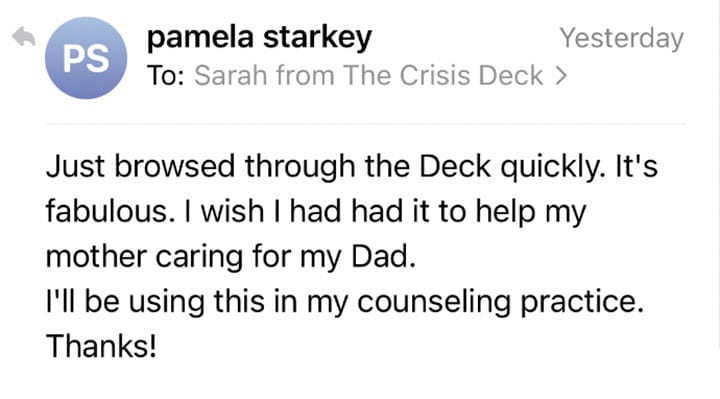
From hundreds of post-purchase responses, the words caregivers used most were: calm, prepared, finally, professional, relief, real.
🆚 Why This Works When Nothing Else Did
| Most caregiving resources | The Crisis Deck |
|---|---|
| Assume you're calm enough to use them | Built for when you're BOTH losing it |
| Teach principles, not words | Gives you the exact words to say |
| Require 6 weeks to see results | Works the next time it happens |
| Generic strategies that don't fit your dynamic | Scripts organized by specific scenario and relationship type |
| One response and you're on your own | Every script includes escalation follow-ups |
| Explain the problem. Not the solution. | Gives you the solution. Not another explanation. |
| Add to your mental load | Reduces it |
| Stuck on one device or one room | On your phone, in your pocket, on the fridge |
🛡️ Try It Risk-Free
That's $0.45/day across the 60-day guarantee. Less than your morning coffee.
💡 Instant access. Use it the next time it happens.
🔒 60-Day "No Questions" Guarantee.
If it doesn't help, you get a full refund and you keep the deck. No guilt. No questions.
You've already tried so many things.
This one was built for the exact moment everything falls apart.
💚 Try The Crisis Deck Without The Risk
You've already tried so many things.
You've read the books at midnight. Joined the Facebook groups. Watched the YouTube videos. And then frozen anyway when the moment actually came.
So here's your chance to try something built for the actual crisis, not the theory of it.
And if it doesn't work?
You'll still feel better knowing you did everything you could.
Let's talk about risk:
Your risk: $27 and 60 seconds to find the right script.
Your upside: A crisis-free day. A conversation that didn't end in tears. Finally feeling like you know what you're doing.
The math: try it ONCE. If it doesn't help, full refund. You're not committing to a course. You're just trying a 3-minute thing the next time it happens."
If it doesn't work: Full refund. Keep the scripts. No questions. No "what did you do wrong."
You literally cannot lose money on this.
Because you deserve something that works.
Or at the very least, something that gives you peace of mind.

In Minutes -
Or It's Free
3 Minutes.
No Prep.
No Guilt.
No More Guilt. Just presence.
4,000+
Caregivers. 91% Saw Change
In 7 Days
⏰ Why Wait Until The Next Crisis?
Because here's the truth… there will be a next one.
Tomorrow morning. This afternoon. Whenever.
But imagine this time, when they refuse, or accuse you, or ask for someone who's been gone for thirty years…
- 🚀 You find the script. You read the words.
- 🚀 You stay calm. Because you finally know what to say.
- 🚀 No argument. No guilt. Just presence.
Because the next 4:07pm is coming whether you're ready or not. And maybe this time, you can be ready.
Frequently Asked Questions
Is this digital or physical — and how do I use it in a crisis?
Digital — and that's the point. Here's exactly what you get:
📱 Mobile-friendly — on your phone in 60 seconds. Bookmark the category you need most. When the crisis hits, you tap, find, read.
🖨️ Print-at-home version — print multiple copies of the pages that matter most. Keep them in the bathroom, the kitchen, the car. Some caregivers print just three scripts and fold them into their pocket.
📄 PDF + ePub + Google Doc included — so you can edit the scripts and have them in whatever format works best for your need.
We designed it this was because a crisis can happen anywhere. Sometimes you have just your phone, sometimes you're in the kitchen. This works either way, no surprise charges, no waiting on shipping to start using it.
I've tried everything. Why would this be different?
Ugh. I know. "Another thing that'll work for everyone else but not my situation."
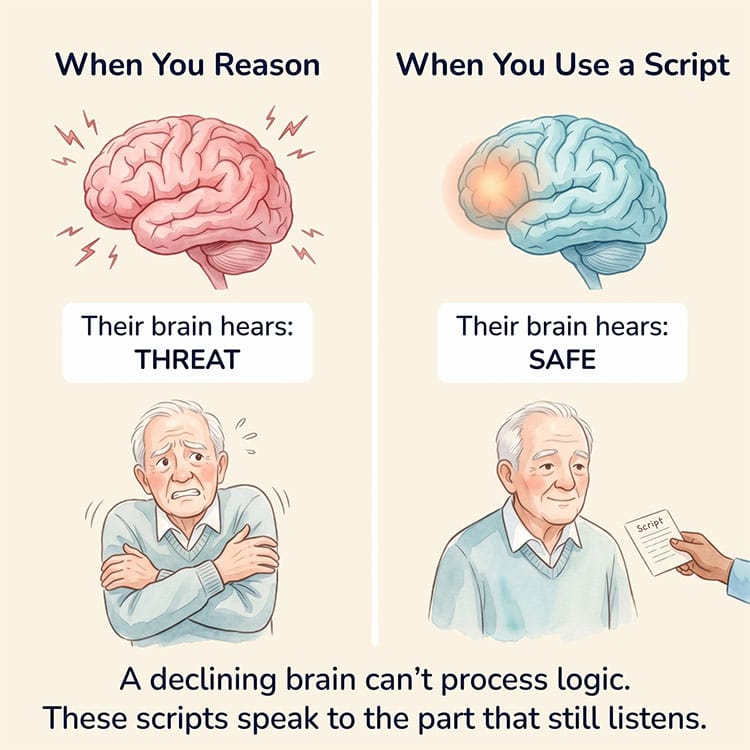
Here's the actual difference: everything you've tried before was probably trying to use logic on a brain that can no longer process it. Explaining. Reminding. Reasoning. These all assume the logical brain is there. But it isn't.
These scripts don't rely on logic. They rely on redirection and emotion — they stop asking your loved one to understand and start helping them feel safe. You haven't tried this yet.
And if they still don't work? Full refund. No guilt. No "what did you do wrong." Just your money back.
Won't this sound scripted or fake?
Does a paramedic sound "fake" when they're saving a life? No. They sound calm and in control. That's what you're going for.
When you use these words, you're speaking to the part of their brain that's still listening — the emotional center, not the logical one. It doesn't sound robotic to them. It sounds like safety.
And honestly? After you use a script once and it works, you stop worrying about sounding natural. Results have a way of doing that.
My situation is too complicated for generic scripts.
The scripts are not generic. They're organized by specific scenario AND relationship dynamic.
Not just "sibling" — but the Golden Child, the One Who Lives Far Away, the One Who Can't Afford To Help, the One Who Criticizes Your Care. Not just "refusal" — but refusal to shower, refusal to take medication, refusal to eat, refusal to get in the car. Each one is different. Each one has its own script.
Every script also includes a customization note. The Script Customization Guide (included free) walks you through adapting any script to your specific person and dynamic.
What if they push back even harder after I use a script?
Every single script includes escalation follow-ups. The first response isn't the hardest — the second and third are. You'll have those too.
Including what to do when they go silent, get angry, play victim, or recruit other family members to pressure you. The scripts assume pushback. They're built for it.
Because real caregiving doesn't end after one line. And neither do these scripts.
Will this work for my husband, mother, father, brother, etc.?
The scripts are designed to work on any loved one experiencing cognitive decline, regardless of your relationship to them.
The unhelpful-sibling conflict scripts are even organized by your relationship to the sibling — because the dynamic between you and a Golden Child sibling is different from the dynamic with an absent one. Same principle applied across the whole deck.
If you're caring for someone whose brain is no longer reliably processing logic and reason — this was built for that situation. Whoever they are to you.
Is this just another "gentle caregiving" thing?
No. Not even a little.
This isn't about being the perfect, endlessly patient caregiver who never raises their voice. This is about having something to reach for in the moment so you don't have to white-knuckle your way through another crisis with nothing but willpower.
Some days you'll still say the wrong thing. Some days will still be hard. But now you'll have more good moments than bad ones. And honestly? That's the whole point.